It’s a Gift to Be Simple

 simple_logic

Theory-based evaluation acknowledges that, intentionally or not, all programs depend on the beliefs influential stakeholders have about the causes and consequences of effective social action. These beliefs are what we call theories, and they guide us when we design, implement, and evaluate programs.

Theories live (imperfectly) in our minds. When we want to clarify them for ourselves or communicate them to others, we represent them as some combination of words and pictures. A popular representation is the ubiquitous logic model, which typically takes the form of box-and-arrow diagrams or relational matrices.

The common wisdom is that developing a logic model helps program staff and evaluators develop a better understanding of a program, which in turn leads to more effective action.

Not to put too fine a point on it, this last statement is a representation of a theory of logic models. I represented the theory with words, which have their limits, yet another form of representation might reveal, hide, or distort different aspects of the theory. In this case, my theory is simple and my representation is simple, so you quickly get the gist of my meaning. Simplicity has its virtues.

It also has its perils. A chief criticism of logic models is that they fail to promote effective action because they are vastly too simple to represent the complexity inherent in a program, its participants, or its social value. This criticism has become more vigorous over time and deserves attention. In considering it, however, I find myself drawn to the other side of the argument, not because I am especially wedded to logic models, but rather to defend the virtues of simplicity. Continue reading

Leave a comment

Filed under Commentary, Evaluation, Program Evaluation

Data-Free Evaluation

 curves

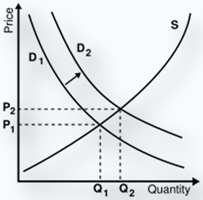
George Bernard Shaw quipped, “If all economists were laid end to end, they would not reach a conclusion.”  However, economists should not be singled out on this account — there is an equal share of controversy awaiting anyone who uses theories to solve social problems.  While there is a great deal of theory-based research in the social sciences, it tends to be more theory than research, and with the universe of ideas dwarfing the available body of empirical evidence, there tends to be little if any agreement on how to achieve practical results.  This was summed up well by another master of the quip, Mark Twain, who observed that the fascinating thing about science is how “one gets such wholesale returns of conjecture out of such a trifling investment of fact.”

Recently, economists have been in the hot seat because of the stimulus package.  However, it is the policymakers who depended on economic advice who are sweating because they were the ones who engaged in what I like to call data-free evaluation.  This is the awkward art of judging the merit of untried or untested programs. Whether it takes the form of a president staunching an unprecedented financial crisis, funding agencies reviewing proposals for new initiatives, or individuals deciding whether to avail themselves of unfamiliar services, data-free evaluation is more the rule than the exception in the world of policies and programs. Continue reading

3 Comments

Filed under Commentary, Design, Evaluation, Program Design, Program Evaluation, Research

The Most Difficult Part of Science

tesla

I recently participated in a panel discussion at the annual meeting of the California Postsecondary Education Commission (CPEC) for recipients of Improving Teacher Quality Grants.  We were discussing the practical challenges of conducting what has been dubbed scientifically-based research (SBR).  While there is some debate over what types of research should fall under this heading, SBR almost always includes randomized trials (experiments) and quasi-experiments (close approximations to experiments) that are used to establish whether a program made a difference. 

SBR is a hot topic because it has found favor with a number of influential funding organizations.  Perhaps the most famous example is the US Department of Education, which vigorously advocates SBR and at times has made it a requirement for funding.  The push for SBR is part of a larger, longer-term trend in which funders have been seeking greater certainty about the social utility of programs they fund.

However, SBR is not the only way to evaluate whether a program made a difference, and not all evaluations set out to do so (as is the case with needs assessment and formative evaluation).  At the same time, not all evaluators want to or can conduct randomized trials.  Consequently, the push for SBR has sparked considerable debate in the evaluation community. Continue reading

1 Comment

Filed under Commentary, Evaluation, Program Evaluation

Conflicts as Conflicting Theories of the World

nyt_2009_01_25

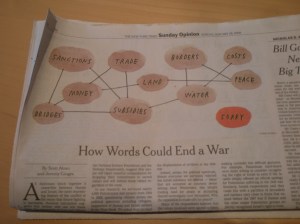
Theories are like bellybuttons-everybody has one and all are surprisingly different.  Last Sunday Scott Atran and Jeremy Ginges wrote an opinion piece for the New York Times in which they described their research on beliefs about conflict and peace in the Middle East.  In brief, they argued that what many outsiders consider rational and logical solutions to the Israeli-Palestinian conflict, insiders consider irrational and illogical.  The reason has largely to do with sacred beliefs.  In spite of the name, these are not religious beliefs, per se, but rather any deeply held beliefs that sit at the core of our world views and are highly resistant to change.

In an earlier post I described beliefs in general as a pile of pick-up sticks, with the most resistant to change-the sacred beliefs-at the bottom of the pile.  Accordingly, altering sacred beliefs in any significant way will disturb all the rest.  At best this is exhausting, at worst traumatic.

Given the variety of beliefs that abound regarding social problems and solutions, it seems that program designers and policymakers are always treading upon someone’s sacred beliefs.  One of the practical questions we have been wrestling with is how to help groups of people with disparate world views reach consensus about programs and policies.  With the approach that we have been developing, we engage a broad range of stakeholders in a simple, iterative process in which they reveal what they believe and why.

Leave a comment

Filed under Commentary, Design, Program Design

Obama’s Inaugural Address Calls for More Evaluation

obama

Today was historic and I was moved by its import.  As I was soaking in the moment, one part of President Obama’s inaugural address caught my attention.  There has been a great deal of discussion in the evaluation community about how an Obama administration will influence the field.  He advocates a strong role for government and nonprofit organizations that serve the social good, but the economy is weak and tax dollars short.  An oft repeated question was whether he would push for more evaluation or less.  He seems to have provided and answer in his inaugural address:

The question we ask today is not whether our government is too big or too small, but whether it works – whether it helps families find jobs at a decent wage, care they can afford, a retirement that is dignified. Where the answer is yes, we intend to move forward. Where the answer is no, programs will end. And those of us who manage the public’s dollars will be held to account – to spend wisely, reform bad habits, and do our business in the light of day – because only then can we restore the vital trust between a people and their government.”

We have yet to learn Obama’s full vision for evaluation, especially the form it will take and how it will be used to improve government.  But his statement seems to put him squarely in step with the bipartisan trend that emerged in the 1990s and has resulted in more-and more rigorous-evaluation.  President Clinton took perhaps the first great strides in this direction, mandating evaluations of social programs in an effort to promote accountability and transparency.  President Bush went further when many of the agencies under his charge developed a detailed (and controversial) working definition of evaluation as scientifically-based research.  What will be Obama’s next step?  Only time will tell.

2 Comments

Filed under Commentary, Evaluation, Program Evaluation

Theory Building and Theory-Based Evaluation

einstein_tbe

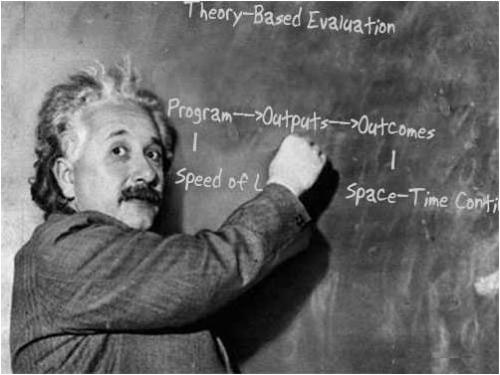
When we are convinced of something, we believe it. But when we believe something, we may not have been convinced. That is, we do not come by all our beliefs through conscious acts of deliberation. It’s a good thing, too, for if we examined the beliefs underlying our every action we wouldn’t get anything done.

When we design or evaluate programs, however, the beliefs underlying these actions do merit close examination. They are our rationale, our foothold in the invisible; they are what endow our struggle to change the world with possibility. Continue reading

2 Comments

Filed under Commentary, Design, Evaluation, Program Design, Program Evaluation, Research

Should We Fear Subjectivity?

ringsmedium1

Like many this summer, I found myself a bit perplexed by the way Olympic athletes in many sports received scores. It was not so much the scoring systems per se that had me flummoxed, although they were far from simple. Rather it was realizing that, while the systems for scoring gymnastics, ice skating, boxing, and sailing had been overhauled over the past few years in an effort to remedy troubling flaws, the complaint that these scores are subjective — and by extension unfair — lingered.

This dissatisfaction reflects an unwritten rule that applies to our efforts to evaluate the quality or merit of any human endeavor: if the evaluation is to be perceived as fair, it must demonstrate that it is not subjective. But is this a useful rule? Before we can wrestle with that question, we need to consider what we mean by subjective and why we feel compelled to avoid it. Continue reading

Leave a comment

Filed under Commentary, Evaluation, Program Evaluation

Asking Questions, Getting Answers

Douglas Adams

Douglas Adams

The late satirical author Douglas Adams spun a yarn about a society determined to discover the meaning of life. After millennia, they had developed a computer so powerful it could provide the answer. Gathering around on that long anticipated day, the people waited for the computer to reveal the answer. It was 42. Puzzled and more than a little angry, the people wanted to know how this could be. The computer responded that the answer to the big question of the meaning of life, the universe and everything was most definitely 42, but as it unfortunately turned out neither the computer nor the people knew exactly what the question was.

A similar fate can befall evaluations, more than one of which has produced a precise answer to a question never framed or a question framed so vaguely as to be useless. It is easy enough to avoid this fate when you realize that, at its most basic level, evaluations address only three big questions: Can it work? Did it work? Will it work again? We call them “Can,” “Do,” and “Will” for short. Of course, we can ask other questions, but they tend to be in support of or in response to the big three. What good is asking, for example, “How does it work?” before you believe that it can, did or will? Continue reading

Leave a comment

Filed under Commentary, Elements of Evaluation, Research

Randomized Trials: Old School, New Trend

surfers

To my mind, surfing hit its peak in the 1950s when relatively light longboards first became available.

Enthusiastic longboarders still ride the waves, of course, but their numbers have dwindled as shorter more maneuverable boards became more fashionable. Happily, longboards are now making a comeback, mostly because they possess a property that shortboards do not: stability. With a stable board novices can quickly experience the thrill of the sport and experts can show off skills like nose walks, drag turns, and tandem riding that are unthinkable using today’s light-as-air shortboards.

The new longboards are different — and, I think, better — because their designs take advantage of modern materials and are more affordable and easier to handle than their predecessors. It just goes to show that everything old becomes new again, and with renewed interest comes the opportunity for improvement.

The same can be said for randomized trials (RTs). They were introduced to the wider field of social sciences in the 1930s, about the time that surfing was being introduced outside of Hawaii. RTs became popular through the 1950s, at least in concept because they can be challenging and expensive to implement. During the 60s, 70s and 80s, RTs were supplanted by simpler and cheaper types of evaluation. But a small and dedicated cadre of evaluators stuck with RTs because of a property that no other form of evaluation has: strong internal validity. RTs make it possible to ascertain with a high degree of certainty — higher than any other type of evaluation — whether a program made a difference. Continue reading

2 Comments

Filed under Commentary, Evaluation, Program Evaluation, Research

What Is An Evaluation?

whatsit

One of my first evaluation projects started with a phone call (e-mail was rare in those long ago days). The conversion went something like this …

“John, we have this grant that requires that we do an evaluation. Sounds great. Love it. Can’t wait to get started. Just one question—What’s an evaluation?”

While a great deal has changed in the years since I fielded that call, I still like to joke that evaluation is the largest profession that no one has heard of. The American Evaluation Association has over 6,000 members, and during the past five years their ranks swelled by 40 percent. Virtually every grant awarded today by a government funding agency, philanthropic foundation or corporation requires an evaluation. Yet evaluators and their work are unknown to most Americans, so much so that at dinner parties I find myself feeling uncomfortable for the poor soul seated next to me who innocently asks, “What do you do?” How can I possibly explain before the table is cleared?

My standard answer is that I help professionals who manage educational and social programs figure out how effective their programs are and find ways to make their programs more effective. I go on to explain that I run a firm in which I and my colleagues specialize in something rather particular and technical called randomized trials. Essentially, these are experiments similar to the ones that doctors and drug companies conduct to ensure that medical treatments are effective. Continue reading

Leave a comment

Filed under Elements of Evaluation